October 28, 1922
M: Son of the CenturyOctober 28, 1922, the date of the March on Rome, stands at the hinge between Fascism’s street mobilization and its rule. The book does not dwell on the march as a single day’s action; instead, it builds toward the date through years of labor conflict and organized violence, then returns to it through the anniversary ceremonies of October 1923. That retrospective view presents the march not as an isolated seizure of power but as the culmination of a political transformation already visible in the streets, the countryside, and public ritual.
The conflicts that preceded the date
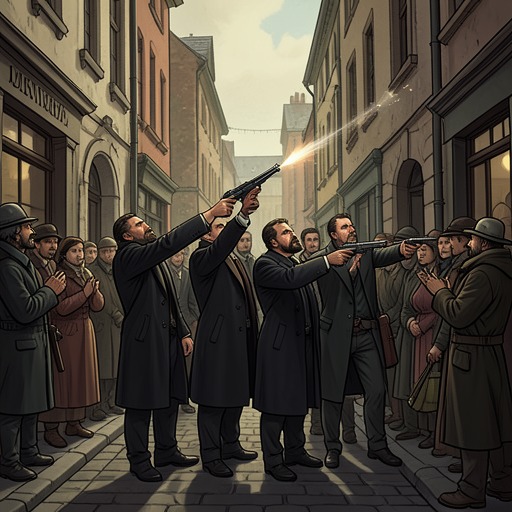
The movement’s ascent unfolded against a background of intense social polarization. On April 15, 1919, tens of thousands of workers gathered at the Milan arena amid expectations of revolutionary upheaval. Several thousand demonstrators broke away and marched toward the Duomo. There, a socialist procession faced a smaller opposing cortege of officers, Arditi, and Futurists. Rocks and clubs came from the socialist side; the opposing group fired first into the air and then at the marchers. The encounter lasted about a minute, but it made the political divide physical: one side arrived singing for a better life, while the other included men accustomed to wartime violence.
The conflict extended well beyond the city. In Bologna, competing labor organizations and pressure to occupy elegant homes sharpened class antagonisms, while union rules and disputes over access to bread placed the middle classes under strain. In the countryside, Socialist Party organizations and peasant leagues exercised influence village by village. By August 1920, those leagues controlled hiring and important parts of agricultural production in Emilia, including work shifts, threshing, seeds, and planting. Ferrara had 81,000 members in its leagues of proletarian unity by mid-May, and landowners had been pushed into accepting rules governing wages, recruitment, labor quotas, and even crop choices. This extensive organization made rural politics a contest over who could direct everyday economic life.
From rural mobilization to political crisis
The account of Ferrara’s Fascist punitive expedition on January 23, 1921, shows the opposing movement adopting coordinated methods of its own. Dozens of armed men set out in trucks provided by the Agrarian Association, aiming to strike several peasant-league centers at once. The plan relied on surprise, force, and simultaneous action. Its organization matters to the story of October 28: Fascist power was being built not only through public speeches but through local networks, transport, weapons, and carefully planned attacks.
Mass mobilization could also be presented as a demonstration of command. At midnight on May 11, thousands of impoverished farmworkers began converging on Ferrara on foot, by bicycle, in wagons, and on barges. The following morning, 50,000 laborers filled the city. Telephone lines were cut, schools requisitioned for lodging, and businesses closed. The spectacle of a countryside pouring into the city showed how political action could paralyze civic life and force authority into negotiation.
A later crisis exposed the state’s vulnerability from another direction. After the Labor Alliance called a legalitarian general strike beginning at midnight on July 31, 1922, Fascist leaders issued an ultimatum giving the state forty-eight hours to demonstrate its authority. The strike was intended to defend political and union liberties, but its premature disclosure disrupted its preparations. The king summoned Facta and pressed him to form a cabinet without the socialists; by late afternoon, Facta had assembled a ministry like its predecessor. The episode placed the state’s indecision and the Fascists’ readiness to claim the right to act in direct contrast.
The march remembered as a beginning
The book’s clearest retrospective link to October 28, 1922, comes at the first anniversary. Mussolini appeared at a Milan assembly on horseback in militia uniform, wearing a fez and black shirt, an Arditi jacket with flames on the lapel, and a dagger at his belt. The mounted leader reviewed troops and associations before addressing a crowd in Piazza Belgioioso, the place where he had held his first Fascist rally four years earlier. The contrast was sharply staged: a few hundred supporters at the earlier gathering had become thousands, and the truck that had served as a platform had given way to a princely palazzo balcony.
Mussolini’s journey to power was condensed into the image of leaving Milan by wagon-lit to conquer Rome. At the anniversary, that earlier departure was no longer an uncertain venture but the foundation of a commemorative narrative. The return to Piazza Belgioioso made the city itself a kind of record of political time: the same location could display the movement’s growth and present its leader as the center of that history.
Anniversary, authority, and political ritual
The anniversary extended beyond speeches into a procession through places associated with Fascism’s beginnings. After a banquet, the cortege followed Via San Marco, passed local Fascist clubs, and stopped outside the modest former offices of Il Popolo d’Italia. Ribbons, garlands, bands, generals, council members, and relatives of the dead filled the commemorative landscape. The municipal mayor announced that a road would bear Mussolini’s name. The route converted remembered locations into a public account of the movement’s ascent.
The ceremony also celebrated the practical consolidation of power. Mussolini cited sixty Council of Ministers meetings, 2,482 matters considered, and 1,658 decrees approved in a year. The Acerbo reform bill was about to become law; the international dispute following the occupation of Corfu had been settled with compensation for Italy; and relations with the Vatican had improved. Meanwhile, internal dissent had been checked, the party leadership was to be chosen from above by the Duce, and censorial decrees had given police new powers over newspaper offices. In the anniversary narrative, the march’s importance therefore lies not only in the movement’s entry into Rome but in the political machinery and restrictions that followed.
The anniversary’s religious imagery deepens that transformation. Five days before the Fascist assembly, the Unknown Soldier had been buried in a solemn national ceremony. The unidentified body, selected by lot to represent the war dead, became the focus of collective mourning. At the anniversary, Fascist founders knelt at the tomb for more than half an hour. The book places this act alongside its observation that politics was becoming a religion: the march’s memory was being sanctified through national symbols, military display, and repeated ceremony.
October 28 thus functions both as a political turning point and as a date that the regime repeatedly interpreted for its own purposes. The 1923 commemoration presented endurance, discipline, and administrative achievement as the harvest of the march, while the earlier episodes show the conflicts and mobilizing practices from which Fascist authority emerged. The later return of mass mourning and demands for justice at Giacomo Matteotti’s funeral in Fratta Polesine in August 1924 also reveals that the anniversary’s triumphant account did not settle the political struggle. The date marked a passage to power, not the end of conflict.